
AI integration for SaaS platforms
From prototype to production-grade AI features.
AI-assisted development & practical AI integration.
From AI insight to real-world automation.
Start a conversation
AI-assisted development
Vibe coding, where AI generates a large part or even all of the code based on specifications, is a fast way to obtain a first working prototype. For example, by using Claude Code.
Software engineering is therefore shifting from writing code to explicitly defining specifications, structuring information, and designing architecture.
For serious production environments and maintaining existing systems, a hybrid approach of AI-assisted development and Experts delivers the best results. AI accelerates development, while Experts safeguard architecture, quality and security. Especially the latter is crucial. Every day we read about data breaches. Don’t let your SaaS end up in the news that way.
The manual first
Good software does not start with technology but with the user. Instead of explaining afterwards how a system should be used, it is much smarter to begin by writing the user documentation before a single line of code is written. This puts user needs at the center.
From that documentation we derive functional specifications, complemented by technical requirements and constraints. This approach forms a solid foundation for building the system.
It also forms the basis for AI integrations such as: information (RAG), interaction (MCP), and automation (Agentic AI), directly from natural language.
Traditional, AI or hybrid
Let your users get things done or retrieve information with AI, directly inside your SaaS environment.
Data entry and retrieval can be handled in many ways: the traditional form-based approach, but also conversational flows, AI chat, or a hybrid form.
Within your SaaS you can inform users how to do something, or users can describe what needs to happen and let AI execute it. You can also combine both: users can ask how something works, or indicate what needs to be done.
Three forms of AI integration
For production-grade AI solutions we work with Microsoft Azure AI Foundry. This is Azure’s platform for building, testing, evaluating and monitoring AI applications.
For SaaS environments, these three forms are most relevant: retrieving relevant information (Retrieval Augmented Generation), interaction (Model Context Protocol), and automation (Agentic AI).
Integration with existing backends (.NET, APIs, SQL, document stores) ensures AI not only explains, but also collaborates in a controlled way with your application and business logic.
AI Information
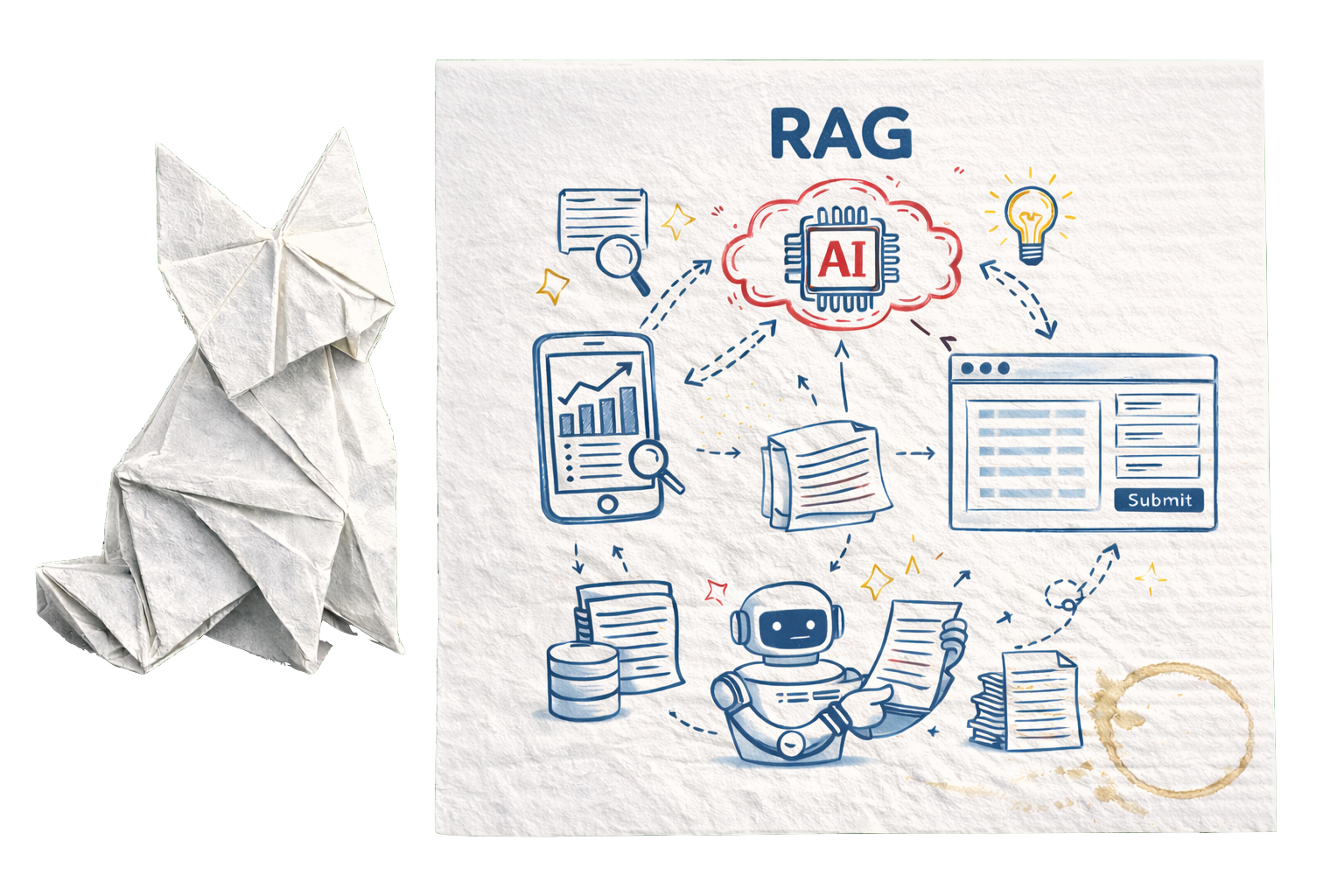
Context matters. Instead of generating generic answers, the system first retrieves relevant information from your documentation, databases or process descriptions. Only then is a response composed.
This keeps the content relevant and directly applicable to a specific situation: a particular screen or process.
Retrieval Augmented Generation
To provide reliable answers based on your own information, we use retrieval-based architectures such as Retrieval Augmented Generation (RAG).
RAG ensures AI responds based on your own data, rather than general or random knowledge.
AI Actions
MCP enables AI not only to explain, but also to perform actions within your system. It is a standard that allows AI models to communicate safely and in a structured way with external systems.
MCP (Model Context Protocol)
With MCP we make interaction smarter: users can enter data, retrieve information or trigger actions using natural language, while the system safely collaborates with your existing logic.
AI Automation
Agentic AI goes one step further: it can independently pursue a goal, determine intermediate steps and combine actions to reach a concrete outcome.
Users describe in natural language what they want to achieve. AI translates this into clear proposals and guides the correct next step.
It can anticipate based on previously executed actions and proactively perform the next step, within the boundaries you define.
Agentic AI
Agentic AI can plan purposefully and execute concrete actions via existing APIs and business logic.
Agentic AI works goal-oriented. You define a goal, for example: “Start a new customer onboarding”, “Check outstanding invoices” or “Prepare a report for quarter X”.
The AI determines the required intermediate steps, retrieves data via your APIs, executes actions within your business logic and returns the result in a structured way.
Phasing
AI can be integrated into existing SaaS solutions without rebuilding the entire system. We start with one clearly defined use case, for example unlocking documentation through RAG. The existing architecture and business logic remain leading.
In new SaaS solutions, AI can be included from the design phase in the data model, authorization structure and API setup. This ensures AI is not a loose add-on, but an integrated part of the architecture.
We work in phases: from one defined use case to expansion per process, role or dataset. This keeps it manageable, testable and safe to roll out.
AI; What else?
When AI is structurally implemented within your SaaS platform, the focus shifts to areas such as data quality and data transparency.
Unstructured or incomplete information, for example customer-supplied import files, can be transformed into structured and directly usable data. No garbage in, so no garbage out.
In addition, usage patterns and trends in datasets can be made visible, including relationships that are not explicitly modeled in the application. And much more is possible.